State of The Art: A Homeschool Studio

I often think that the night is more alive and more richly colored than the day.

Vincent Van Gogh

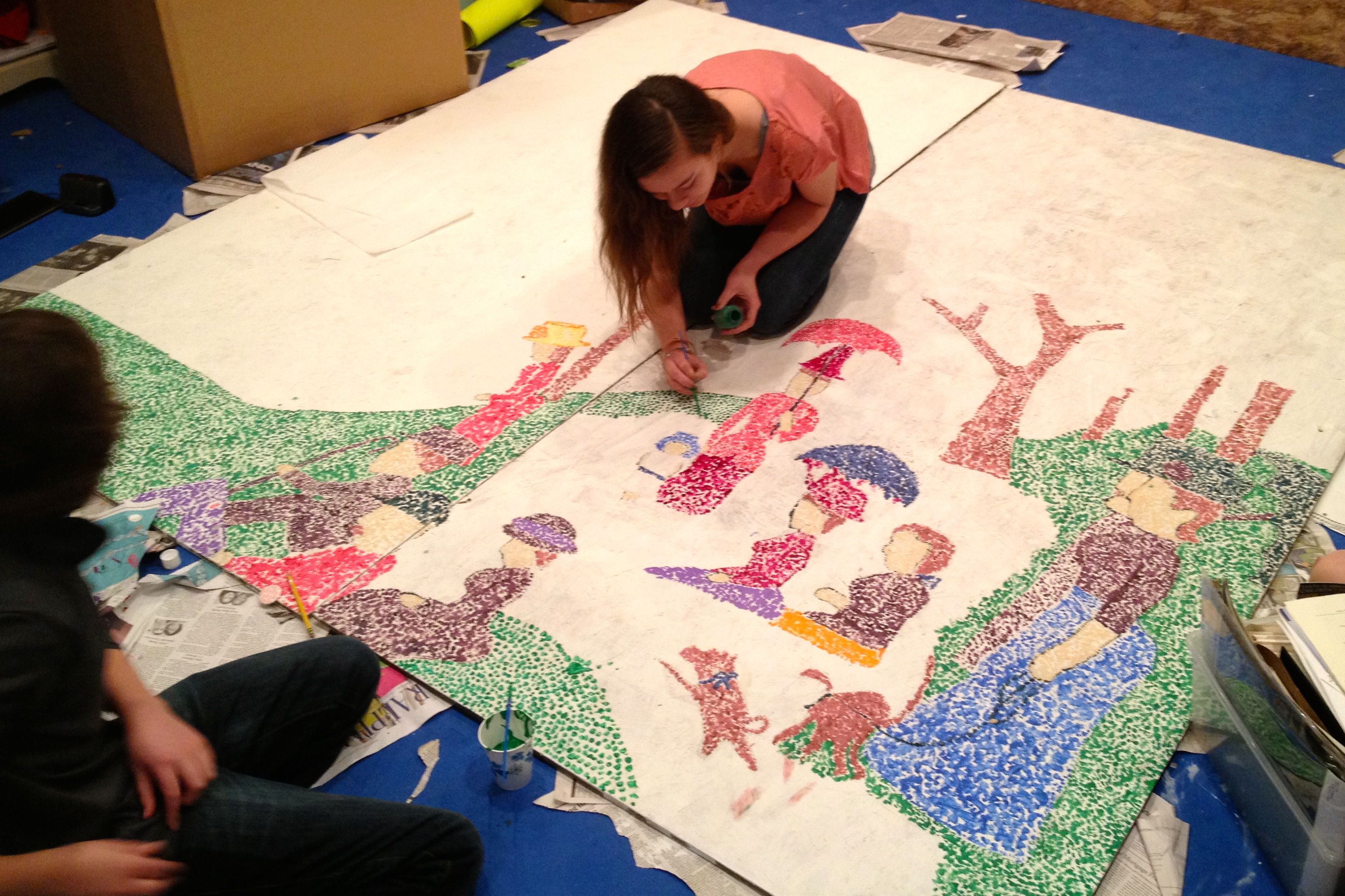
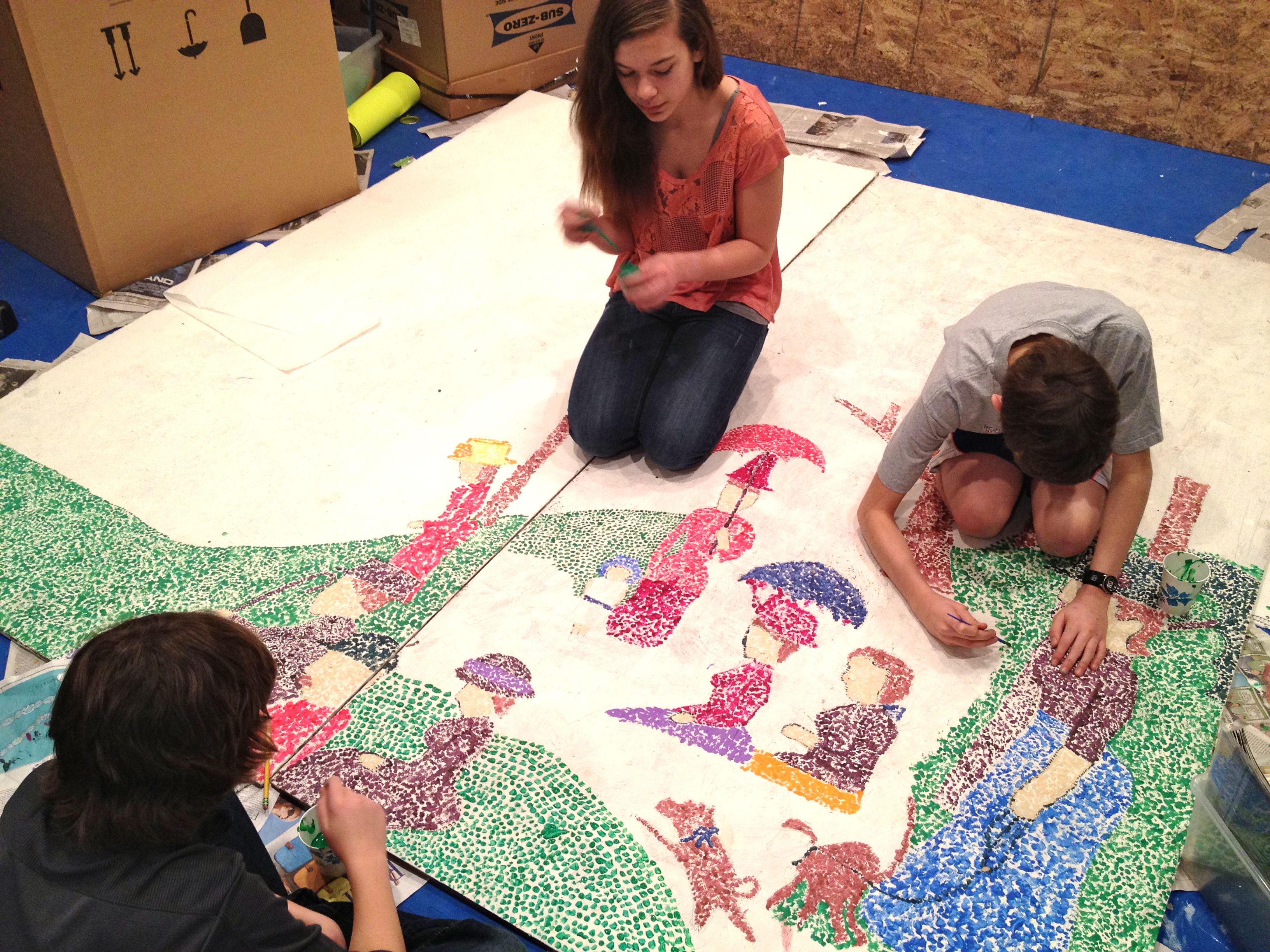
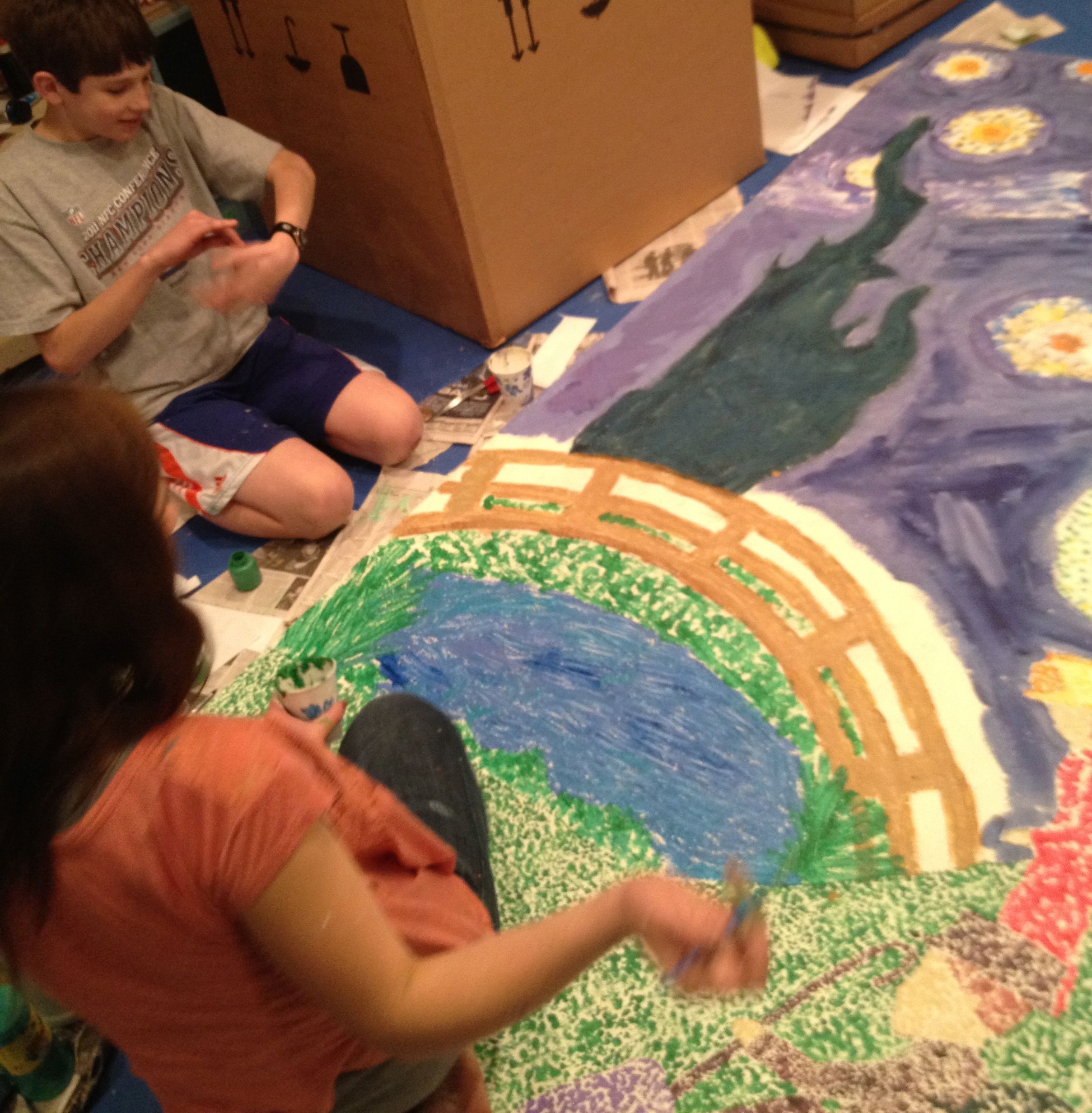
The best part of art is getting a chance to make it yourself.  With this in mind, Happymess kids have invited their friends over for an all-day art festival.  They plan to take their studies in to their own hands, literally, and create the paintings they have been studying.

Happymess kids have been studying Impressionism, modern 20th century art and various forms of sculpture.  They are particularly interested in Pointillism.   This school year, Happymess kids have had great fun visiting several museums in NYC and Washington, DC.

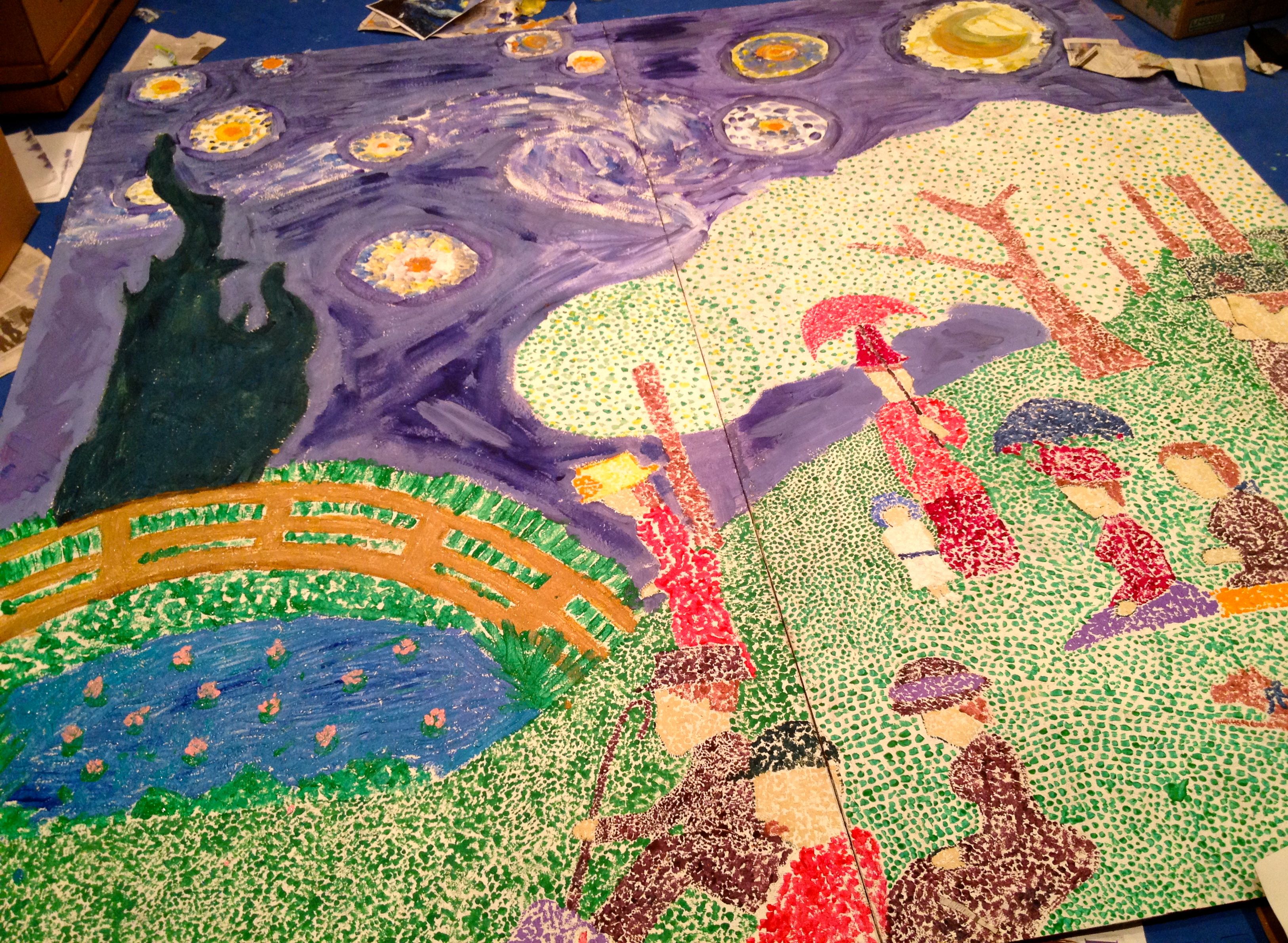
The artists they most want to learn from are Seurat, Van Gogh and Monet.  They have chosen three specific works to study.

Seurat: La Grande Jatte

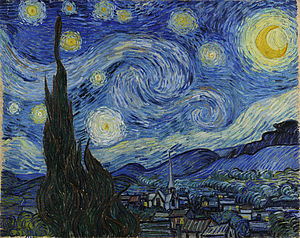
Van Gogh: Starry Starry Night

Monet: Water Lillies

It is now time to try their hand at the artistic process.

They want to create a composite painting that will encompass several different Impressionist techniques and will reflect the work of Monet, Van Gogh and Seurat.

 We have almost a dozen children filling our small art studio.  They are involved in several projects simultaneously:  painting, gluing, folding, drawing and drilling.  The biggest obstacle is trying not to step on wet paint and buckets of glue.

The younger group is creating a sculpture from found objects.  This is a major project, with this being only the first step but they are hard at work building, gluing and constructing separate pieces to be added later.

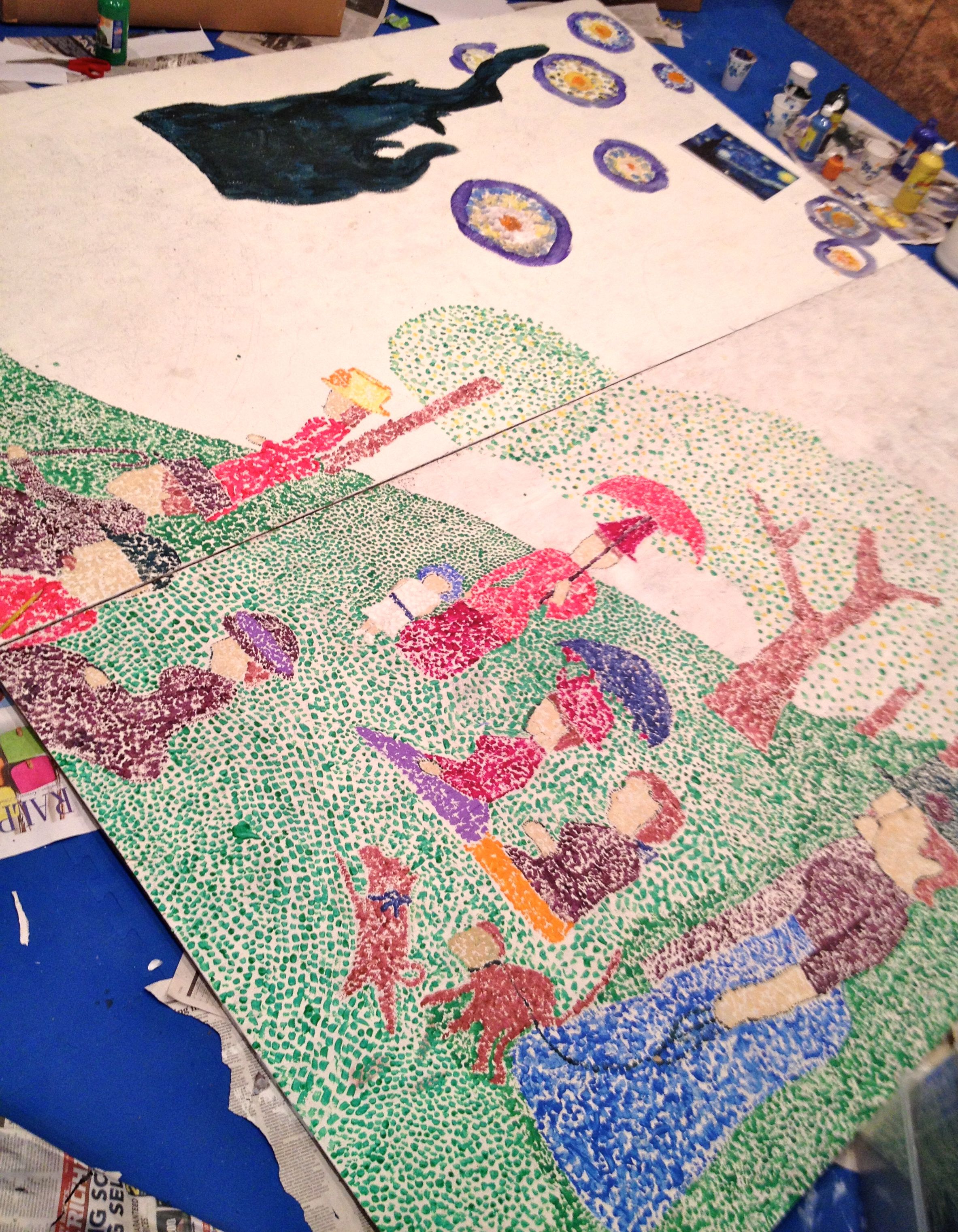
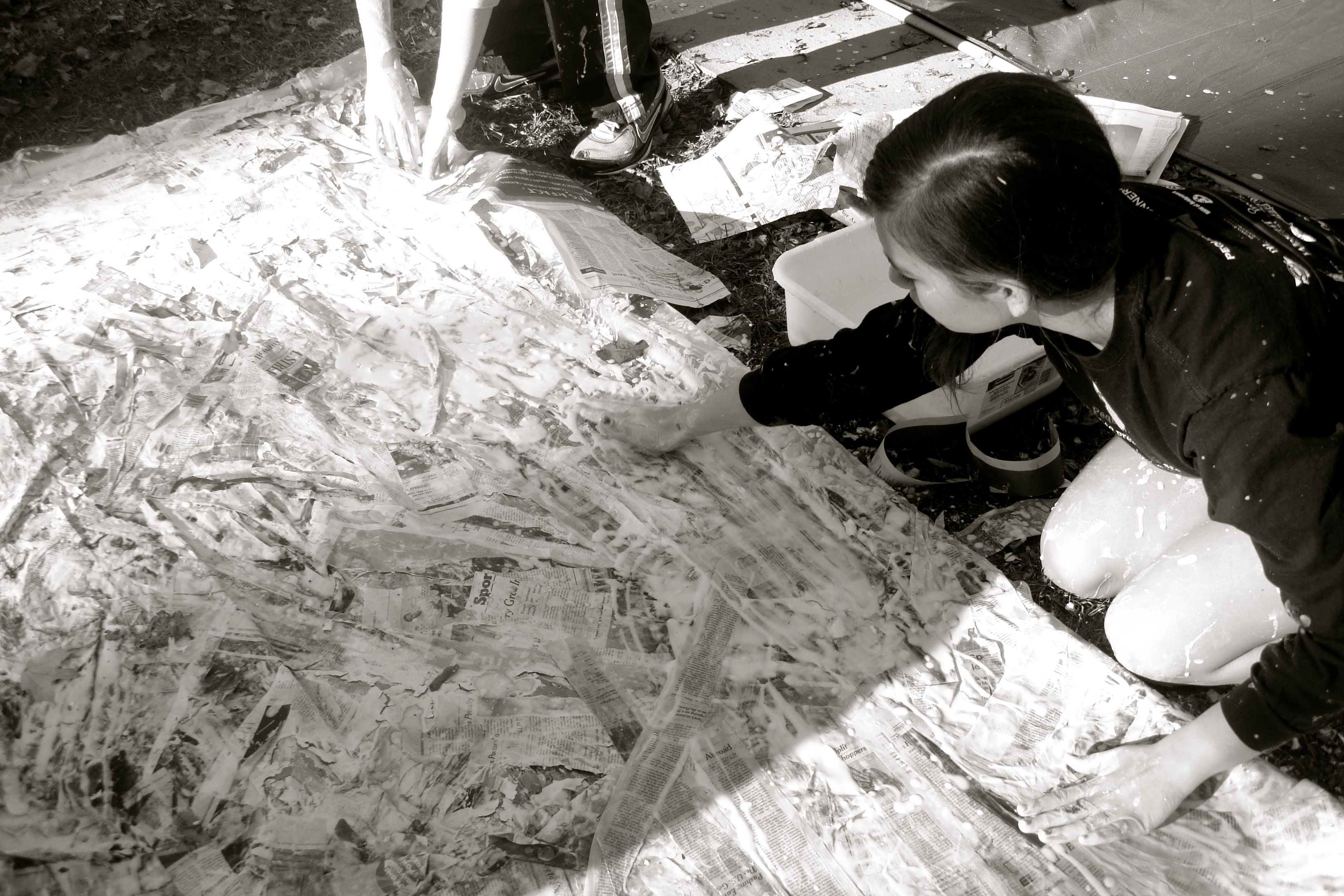
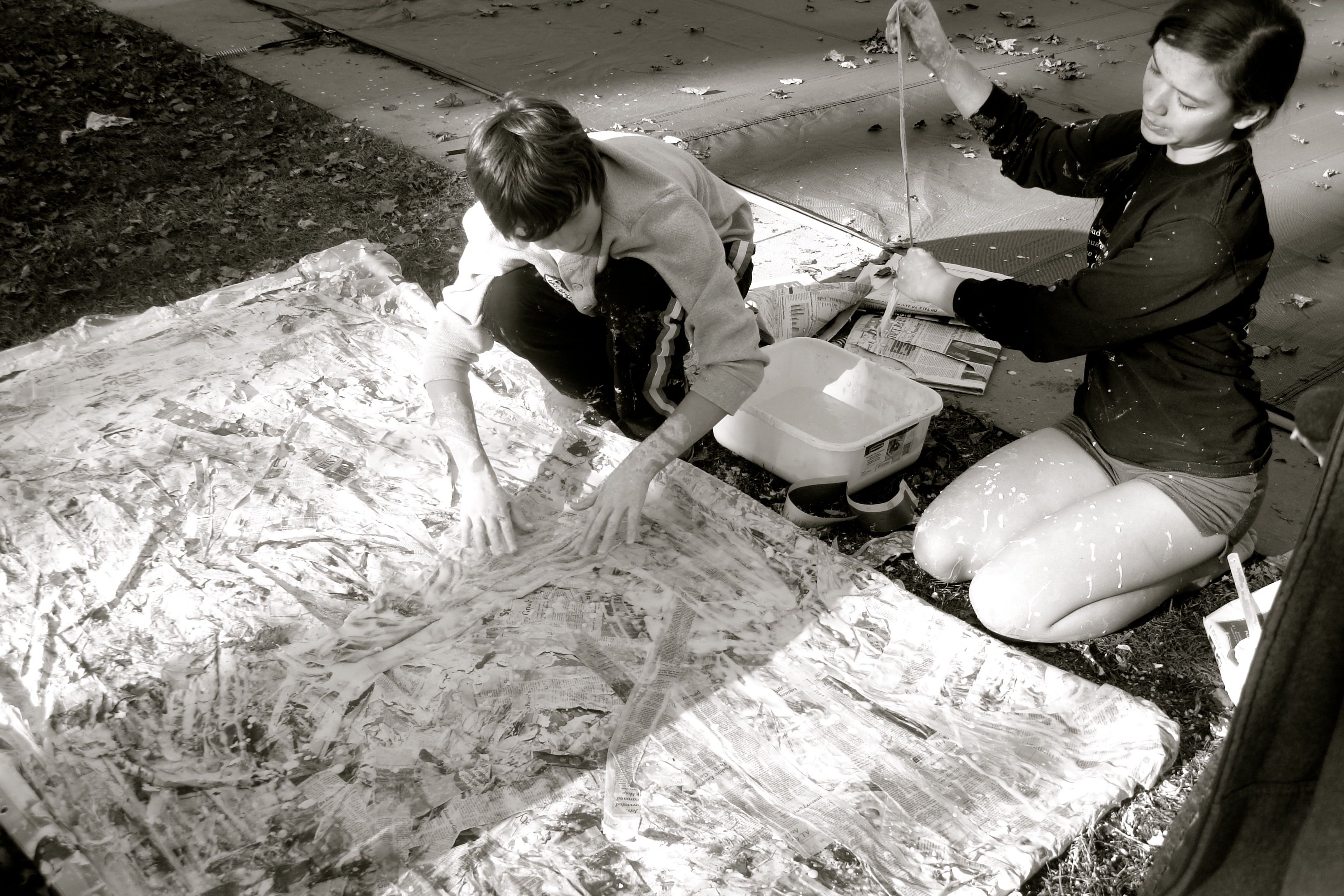
Meanwhile, Van Gogh is beginning to make an appearance in this Impressionist collage…

Quantum is learning origami.  He is hoping, with his friends, to fold 1000 cranes so they can make a wish for good luck.

It is time to begin adding Monet to the masterpiece…

Finally, the composite Impressionist painting is completed.  The final painting is 8’ by 8’ and has been painted, in one day, by a total 5 student painters.

The best way to know God is to love many things.  Vincent Van Gogh

Let Me Count the Days:  Homeschooling is spending the entire day in the art room, studying and painting in the tradition of the grand salons.

Writing Assignment: Using Non-Chronological Sequencing to Heighten Suspense

Happymess kids are perfecting their creative writing skills.  Quantum is hard at work on his current narrative assignment.  The assignment is to take a small (actual) misdemeanor and turn this episode of misbehavior into a fictional narrative that evokes an element of mystery or fear.  The method?  Beginning in the middle or the end.

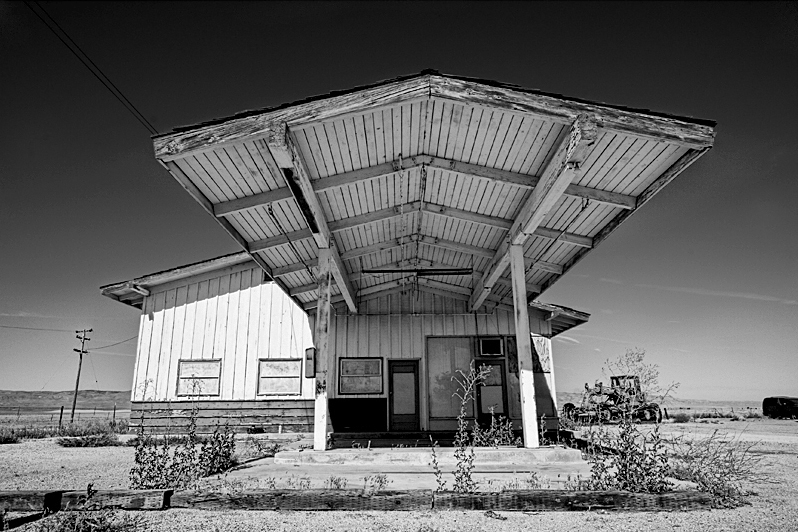
Quantum chose a time when he “hid” in the back seat of the car so that he could attend his older brother’s college football game.  In actuality, we knew he was there and we were delighted to have him.  In Quantum’ s fictionalized account the young boy remains hidden until he gets out, unnoticed, at a country gas station.  He intends to secretly re-enter the car but his timing is wrong and his parents, unknowingly, drive off without him.

Quantum wrote this story from beginning to end, in correct chronological sequence.  He then chose a sentence from the middle of the story,

“It was hot and stuffy in the trunk and I was getting hungry.  I was wondering if my parents would ever stop for gas…”

This became the new beginning of his tale.  From the inside of the trunk we experience the boy’s discomfort and regret.  When the boy is abandoned at the gas station he is befriended by an old man.  The man encourages the boy to call his parents and tell them the truth.

By inverting the sequence of events and fictionalizing a small misdemeanor Quantum is able to create an entirely new, and suspenseful story.   He uses extensive dialogue to express the thoughts and feelings of his characters.  After calling his parents the boy is left waiting to be picked up at the gas station.  We know the dad is angry but the reader waits with the boy, in suspense.  We can only imagine what the punishment will be.  Will the dad be as angry as the boy imagines or will Dad be forgiving and understanding, as the old man at the gas station believes?  Quantum leaves these final questions unanswered so the reader can supply their own ending.

The technique of fictionalizing a small bit of truth and then inverting the sequence is successful in creating suspense.  Starting with a misdemeanor and writing a beginning to end story with liberal fictionalization was an easy way to get Quantum writing.

We like to begin our writing sessions (after planning) with several 15 minute free-writes.  Quantum sketched out a general idea for his story, “hiding in the trunk” a climax, “lost boy” and a theme, “reckless behavior can lead to unexpected consequences” and an uncertain ending, “would the boy be forgiven?”

Once the events and order had been established, it was…On your mark, get set, GO…15 minutes of non-stop writing, no time for perfection, just get the story down on paper.

After re-reading his free write Quantum chose his middle sentence and started from this point.  He began to write more thoughtfully and slowly, really taking the time to build the story in the mind of the reader.  Now he had to make us feel the inside of the trunk, and see the barren gas station, he had to make us worry about this boy by himself, his decision to trust the only adult, an unknown male.  We were rooting for him to finally call his parents.  We knew they would be shocked and worried.  We knew they would turn around immediately and pick him up.  Of course they would be angry, but would they understand and forgive?  Most importantly, will this boy finally get to see his brother’s college football game?

By starting. In the middle, and not answering all our questions, Quantum has created a tale of mystery and suspense.  Most importantly, this technique enabled a novice writer to begin at the beginning, initially, and to feel comfortable creating an imaginary story that rings true.  Following these basic stair step exercises demystifies the writing process and brings simplicity and joy instead of tears and frustration to the creative writing process.

Happymess Kids Practice the Dark Art of Writing

Let Me Count the Days:  Homeschooling is striving to make the impossible attainable.

Finding Creative Inspiration

Creative inspiration is a necessary ingredient for every part of life, but certainly needed when educating and inspiring children. We need to be creative in our approach so our students are engaged and we need to continually reinvent the lesson to maintain both their level of interest and our own.

thinker

So where do we find our creative inspiration? Our Happymess approach is usually to look at each lesson as part of an inter-disciplinary component.

We ask ourselves, "How does this one piece of learning fit into the giant puzzle of knowledge?" I typically try to find at least 3 different disciplines related to each individual subject. I try to surround our nugget of factual study with small pieces of art, history or literature that will make the "fact" seem more "real" to our aspiring student.

For example, when studying math we ask ourselves, "Why is this really necessary? Who has used this knowledge in the past?" "Why might we be interested in knowing this in the future?"

These type of questions quickly lead us to a study of history, both ancient and modern. We can look at the ancient Greek philosophers and mathematicians and learn how they studied the general principles of the world. We can study the lives of Euclid and Pythagoras and learn about the Euclidean algorithm for determining the greatest common divisor, or in Saxon Math terms, the greatest common factor (GCF). We study Pythagoras' theorem for determining the hypotenuse of a right triangle: a squared + b squared = c squared.

We see immediately that these are not merely formulas to be memorized. These are scientific principles that govern our natural world. These principles were observed by great minds of the past and were simplified into tangible equations.

So now as we commence our exercises we see that these Saxon math questions are part of an ancient dialogue. These questions have been asked, studied and answered for thousands of years. So "Why," our student wonders, "do we need to keep studying them?"

This is an excellent time to look at some current scientific uses for which these theorems can be helpful. They include use of GPS, navigating in outer space and measuring areas of a building or bridge for the purpose of construction.

Athena and I were recently purchasing tile for our kitchen. We went to several tile stores and were unable to determine the exact cost of the tile due to the lack of unit pricing. The salesperson was unable to provide us with a unit cost per square foot so that we could compare various prices of tile. After tap-tap-tapping repeatedly on her calculator she finally looked up sheepishly and said, "They just don't give us an app for that so I can't answer the question." Then she turned to Athena and said with a smile, "You see, that's why you have to study math in school." Athena just smiled back because she had already calculated the various sums in her head while pretending to study the ceiling.

We left the store thanking Pythagoras and his ancient friends for enabling us to get an honest price quote. Expanding the relevance of an otherwise "dry"

subject takes a creative approach but makes it much more fun to teach and much more entertaining to learn.

Where do we find our creative inspiration? We just keeping asking, "Why?" and "Who?" and "When?" each time we learn a new fact.

Let Me Count the Days: Homeschooling is searching to find the past and the future while struggling to understand the present.

Powered by Plinky

It is Destination Imagination Creation Time

Our Destination Imagination teams are busy building, creating and constructing all types of props for their team Challenges which will be presented, in dramatic form, mid-March.  In total, no team can spend more than $125 so our team members are making all their sets and props from scratch, found objects and recycled trash.This team has finally engineered a device which will transport their teammates across the continents.  Later they will add many features and decorations but for now…all that must remain top secret.

Meanwhile, the elementary level children are hard at work creating their very own…Luminaries!.  Their Challenge play must be performed in the dark…and explain the present and future applications of solar energy.

It is now evening, pitch dark and shivery cold,  But the upper level team continues with….

Giant paper mache backdrops which they can use as frescoes for their paintings….

Destination Imagination:  It’s a way of life!

Let Me Count the Ways:  Homeschooling is always having a bigger happymess in your house, just after everything has been cleaned.

The Poem: A Costless Lesson Plan for the Thrifty Homeschooler

We have found that a simple poem, quote or Bible verse can provide hours of education across several disciplines.  The cost?  Absolutely nothing.

The Water Harp (Allia)

I like the following poem as it has an educationally relevant message

There is no frigate like a book   

To take us lands away,

Nor any coursers like a page   

Of prancing poetry.   

This traverse may the poorest take        

Without oppress of toll; How frugal is the chariot   

That bears a human soul!

By Emily Dickenson

We begin our lesson with handwriting.  The students copy this poem using their best possible handwriting.  We do this with a pencil so that individual letters and words can be reworked without ruining the whole.

Notice that each line of poetry begins with a capital letter.  Be sure your writers copy the correct punctuation.  Poetry often uses commas to indicate a continuity of thought, despite a line break.

Next we study vocabulary.  Be sure your reader knows the meaning of each word:

Frigate, nor, coursers, prancing, traverse, oppress, toll, frugal, chariot, bears

Have your students copy each word and its dictionary definition.  Be sure they know the spelling of each word and use it in a sentence of their own.

Example:

Frigate: a fast navel vessel of the late 18th and early 19th centuries, generally having a lofty ship rig and heavily armed on one or two decks.

The pirates were no match for the heavy armament of the frigate and were forced to find smaller prey.

Now try reading the poem aloud.  Listen carefully to the way rhythm is used.

Once every word has been defined we can go back and examine the poem.  What does it mean?  This is great for class discussion.  We talk about the actual meaning, the implied meaning and how this poem makes us feel and think about our own relationship with books.

Now we can study poetry and language.

Wikipedia, not always my favorite source, has an excellent discussion on the history and development of poetry and poetic language

http://en.wikipedia.org/wiki/Poetry

For convenience, I am including a segment here:

Poetry is primarily governed by idiosyncratic forms and conventions to suggest differential interpretation to words, or to evoke emotive responses. Devices such as assonance, alliteration, onomatopoeia, and rhythm are sometimes used to achieve musical or incantatory effects. The use of ambiguity, symbolism, irony, and other stylistic elements of poetic diction often leaves a poem open to multiple interpretations. Similarly, metaphor, simile, and metonymy[5] create a resonance between otherwise disparate images—a layering of meanings, forming connections previously not perceived. Kindred forms of resonance may exist, between individual verses, in their patterns of rhyme or rhythm.

This is an excellent time to teach the meaning of various literary terms.  You may choose to study one term a day.  Learn the definition of alliteration, find examples of it in poetry, then experiment with creating your own sentences using alliteration.  Understanding and using some of the above literary devices will greatly enhance both the students’ comprehension of literature as well as improve their writing technique.

For the purpose of this lesson we will concentrate on the following two literary terms: metaphor and simile. Have your student define each term and then find each example of a metaphor and a simile within the poem.  Have them write one example of each on their own.

Discuss:  How has the use of metaphors and similes enhanced our understanding of Dickenson’s message?

Each piece of literature should be understood within its historical context.  So now it is time for a brief history lesson.  So we ask, who is Emily Dickenson and when did she live?  What forces influenced her thinking, writing style and perspective?

This link will bring you to an excellent, and exceedingly thorough discussion published in The Cambridge History of English and American Literature in 18 Volumes (1907–21).

http://www.bartleby.com/227/0302.html

Emily Dickenson was born in 1830, lived in New England and was surrounded by the Puritan faith.  How did this world vision influence her poetic works?  Did she follow her faith or was she a rebel within her society?  You may want to have a short history lesson on Puritanism and early American values.

It is now time for our writing lesson.  We will begin with the essay.  An essay is a short (depending on the age of your student) formal piece of writing that addresses a specific topic.  We suggest 3-5 paragraphs.  Have your student pick a topic relevant to today’s discussion. This is a good time to introduce the idea of beginning with a topic sentence and an outline.  Be sure the student includes: title, introduction, middle, and conclusion.  The essay can be further enhanced through the inclusion of specific examples, or quotes from sources.  Now you can explain how to footnote, or give credit for cited works.  Recopying the essay is an excellent opportunity to practice both rewriting and handwriting.

An alternative writing lesson is to have your students write their own poem.  Try to have them use metaphors or similes.  You may also ask them to use nature as an inspiration.  Again, have them recopy their poem using their best handwriting.

Every homeschool day must include art, and today is no exception.  Let your student create an illustration for Emily Dickenson’s poem and one for their own poem.  They may want to further decorate their own picture by including their poem (more handwriting) and adding a frame or border.

This final piece may make a beautiful decoration for your schoolroom, or perhaps, your students will have a wonderful gift to share with someone they love.

Another writing exercise can be a journal entry.  Have your students write a personal commentary on what this poem means to them.  Come back to the poem after several months, or towards the end of the school year, and see if the student finds new meaning in the poem.

We are not quite done yet.  You have begun the study of poetry, why not continue with a poetry reading?  Reading aloud greatly enhances literary fluency and diction.  We love to sit by the fire, sip hot chocolate and surround ourselves with piles of poetry books.  Our favorite is a series called Poetry for Young People.

http://www.sterlingpublishing.com/catalog?limit=10&section_key=21-32&offset=10

These books feature classic poets and each page is beautifully illustrated.

Now that your children are exposed to various poems and poets, have them pick a favorite poem.   They should memorize this poem.  Once they have memorized it they can practice reciting their poem.  This is a great time to teach the basics of public speaking:  the importance of knowing your material, speaking clearly, loudly and articulately, remembering to look at your audience, standing straight and remembering to breathe.  Now find an audience, and invite some other homeschooling families to participate and you can host a Poetry Party.  (Note:  great time for your kids to practice their cooking skills.)

Wow!  It has been a busy day!  It must finally be time to play!  See if your students can create metaphors for the world they find outside:

Pumpkin Siblings (Allia)

Example:  The crisp, crunchy leaves of autumn sing of pumpkins and sharp skies of fall.

Let Me Count the Days:  Homeschooling is finding an entire day’s lesson in 7 lines of poetry.

Writing Assignment: Seeing Myself Through the Eyes of Another

Happymess kids are learning to write.  This week Quantum is completing an assignment in which he has to describe himself (in the third person) through the eyes of a grandparent.  Through this process he will additionally be describing the grandparent and will introduce the reader to Quantum as perceived by the grandparent.  Thus, some of Quantum’s positive attributes may be viewed negatively and some seemingly unimportant moments may be accentuated due to the values of the grandparent.

,This story is a fictionalization of an actual encounter, in a restaurant, between Grandfather and Quantum.  Grandfather is delighted that Quantum is dressed appropriately but does not think children should receive too much attention or praise.  This piece is both comical and sad as the two males, at either end of the age spectrum, miscommunicate and misjudge one another.  The opportunity for mutual appreciation is certainly lost through this encounter.  Quantum effectively uses fictionalization to emphasize the mood he strives to create.

Quantum eagerly attempts to share his interests and accolades while Grandfather dismisses these attributes with sharp-tongued staccato remarks designed to remind Quantum of his more junior place at the dinner table.

Said by Quantum, admiringly,  “Grandfather, did you ever get to see Babe Ruth?”

“My father wouldn’t have cared if Babe Ruth was sitting in the backyard!” Grandfather retorts, disparagingly.

Through this exercise Quantum is learning the craft of character description, setting and the use of dialogue and innuendo to create an effective and moving scene.  This writing exercise builds upon real world facts while allowing extensive room for creativity.  The students’ sense of security is enhanced in that initially they are reporting on known events.  The focus on pure creativity is reduced.  As the tale unfolds the student is free to rearrange the details as she/he learns to use words to illustrate the tale.

Garth Williams

This assignment helps to bridge the gap between reality and fiction.  It also helps to illustrate the manner in which fiction can be more truthful than facts.  Sometimes a fictional portrayal of an event more closely reassembles the truth, as perceived by the individual.  Third person self-description in an excellent introduction into the craft of fictional character development and can be employed in a writing program designed for any age student.

Would you be interested in using this technique to expand the writing skills of your students?

What techniques have you used effectively?

History is the Study of Lives, not Events

"Those who cannot remember the past are condemned to repeat it."

George Santayana, also invoked by Winston Churchill

Napoleon, Empereur de francais…

A typical history course is one which follows a fairly straight forward, chronological, path through a series of wars and various social and cultural upheavals. This approach to the subject of history can be uninspiring to the young student. When I first began homeschooling I searched for a good history curriculum and was surprised (not really) that the textbooks where dull and the "story" moved intractably from one violent event to the next with little human empathy or emotion being imparted to the reader.

Inevitably I found that I needed to create my own curriculum if I wanted to get my students' attention. In the past 6 years we have studied the ancient Egyptians, the ancient Greeks and Romans, the history of China from 1000 b.c. through Mao and the Cultural Revolution to the present, the history of Japan, the American Revolution, slavery and the Underground Railroad, World War I, the inter-war years and World War II, and at least another dozen sub-topics.

I have found that the best approach is to start with a simple skeleton or outline of the basic facts. This is reinforced by having my students create their own timelines of the key events. For this we have used long rolls of paper that stretch across the room. The timeline can be marked with measurements reflecting the desired time intervals. The students then write draw and create a collage of events, images and accomplishments from that section of history. We have also used printed book timelines that allow multiple timelines to be created on the same page so that various events from around the globe can be compared and the student can appreciate the different events that were occurring simultaneously. We have also used digital timelines that create the same effect but allow for uploading images and films to create a newsreel effect.

I have found, not surprisingly, that the best materials are the primary sources. When we are able to read a first person account of an event then the moment truly becomes "alive." Suddenly it is apparent that real people have lived and thought and tasted these events. We care about the event because we care about the people. Wasn't that the whole point anyway?

We have also had great success reading literature, seeing theatrical pieces and visiting museums. All these resources give a sense of how the past is both similar to and different from the present. We always consider the questions, "How is this similar to today?" and "In what ways are these issues still affecting our society?" also, "Is our culture really different or have these driving forces just manifested themselves differently?"

Ultimately we still turn to respected historical resources for information and analysis. After doing so much of our own research these texts provide real benefit. The student can discern from what viewpoint the text has been written and can evaluate which information has the most value. The study of history becomes the study of our lives and our predecessors, and as such, the study of history becomes indispensable to our study of humanity.
Powered by Plinky

The Big E Captures the Romance of the Country Fair

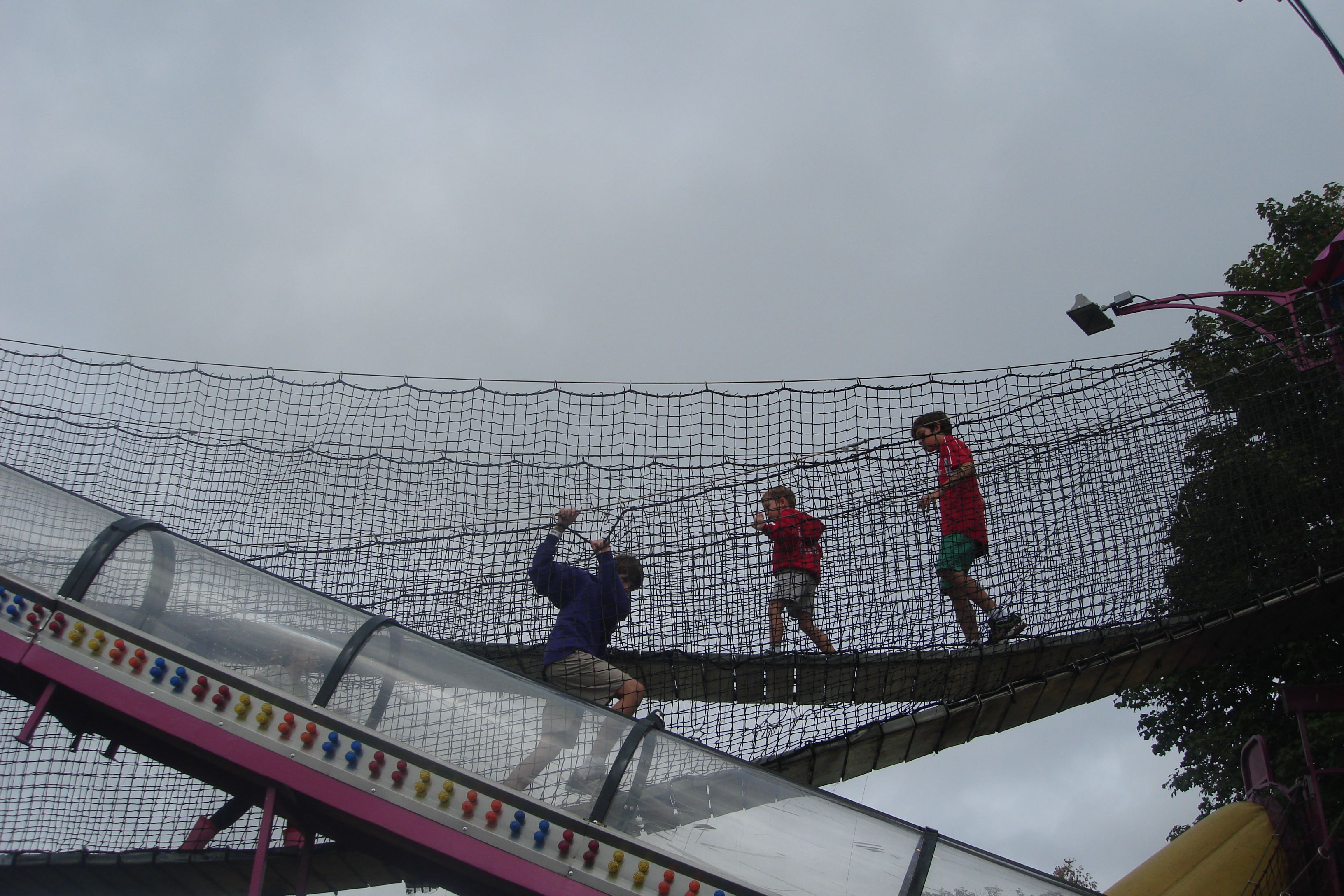
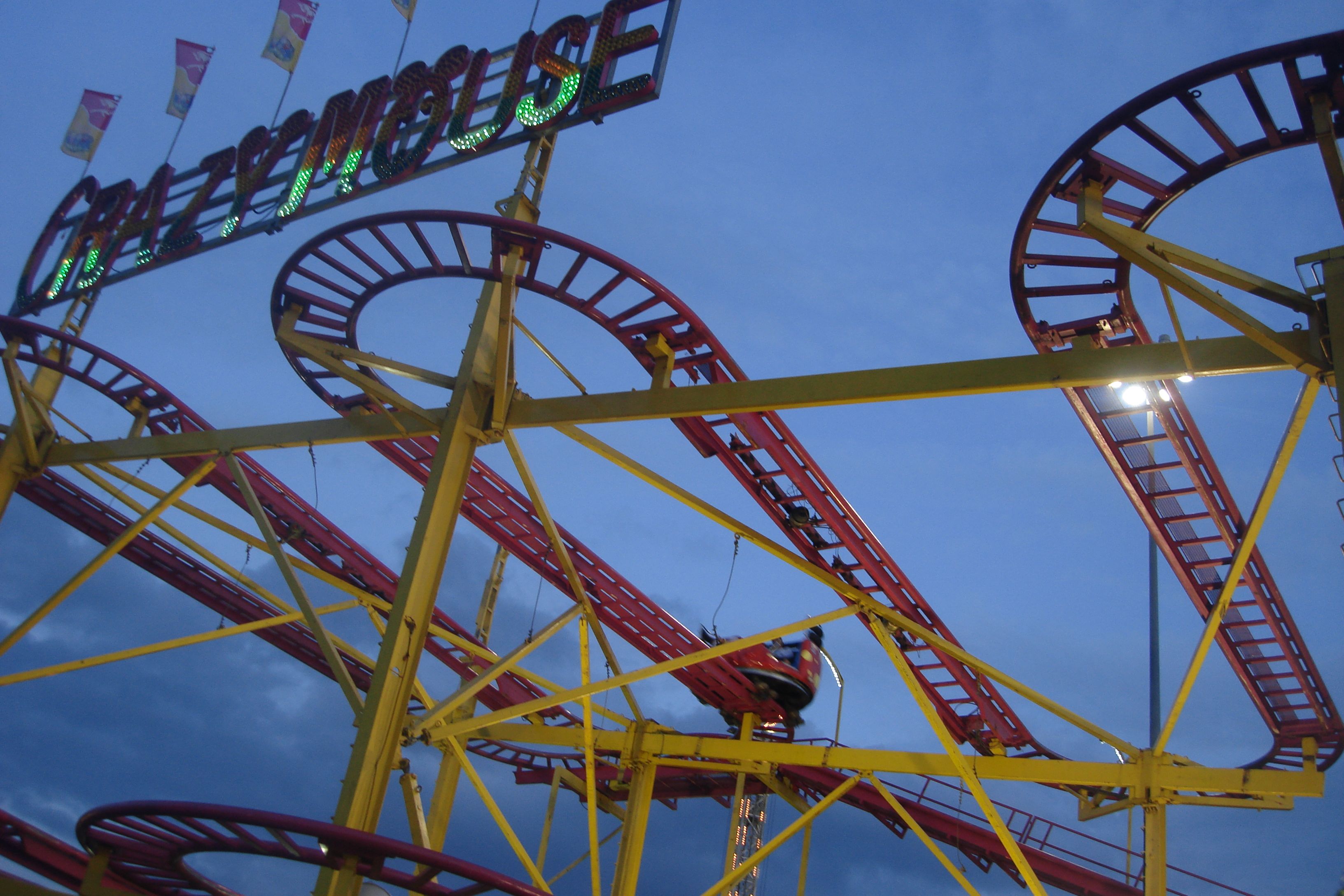
A recent visit to the Big E, Eastern States Exposition, gave our 21st century urban children the opportunity to experience a good old fashioned country fair.  We visited farm stands, tasted cream puffs, rode on an elephant, saw real farm animals (I know to some that may sound mundane), rode on real farm tractors and went on as many spinning ferris wheels and roller coasters as possible.  Oh..and saw the most amazing one ring circus in which each act really was death defying and heart stopping. 
Bounce and Quantum may now believe that goats and camels reside happily side-by-side on most American farms.

Riding on an elephant is not nearly as easy as one would imagine when reading the Arabian Nights.

Watching piglets nurse and eggs hatch was endlessly fascinating to our urban-suburban group, most of whom are only familiar with cats and dogs and assume all pigs and spiders are friends, like Wilbur and Charlotte.

Of course nothing can compare with chasing one another through nets and tubes 100 feet above the ground.

Except, perhaps, riding high on a swing hundreds of feet above the earth.

Crazy Mouse at dusk: this was everyone’s favorite ride.

It was a beautiful day, made even more magical by sunset.  This was certainly a “naturally inspiring” lesson in our ongoing study of early American History.  Don’t worry, another day will be filled with proper lessons, notes and quizzes. But today will remain in all our memories as a tour of old-fashioned Americana, and of good plain fun, along the scale of Wilbur and Charlotte’s country fair.

Literature as a Window on History: The Crucible

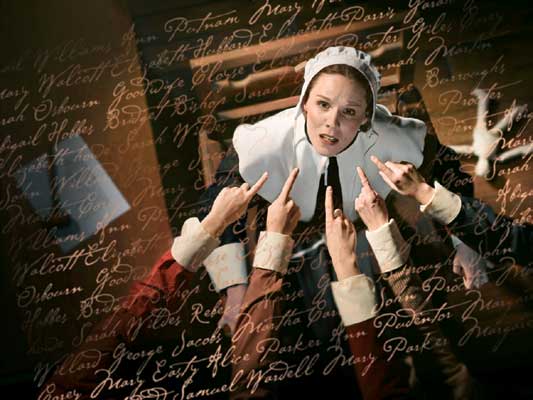
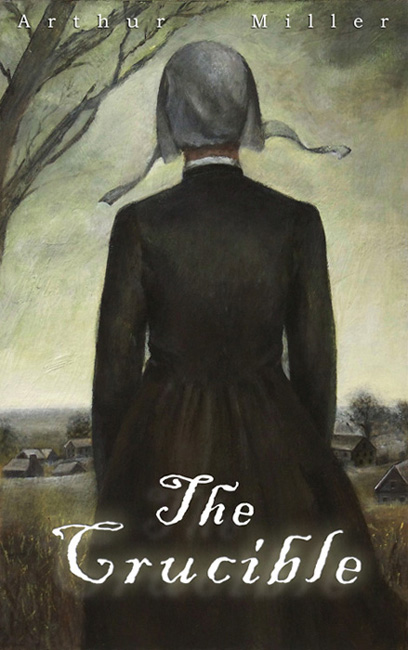
We are opening our school literature season with a reading of the play, The Crucible by Henry Miller.  This play, written in the 1950’s, revisits Salem Massachusetts at the time of the Salem witch trials.   Today we discussed the nature of the insular Puritan society and the perceived impropriety of two girls caught dancing in the woods.  We discussed the ease with which a small lie can escalate into a communal lie and how quickly a community can rush to persecute the individual, in particular to protect itself from humiliation, or in this case, death.

This play was produced during the era of McCarthyism and ominously warns of the dangers in fearing the unknown and in erroneously accusing others. The notorious witchhunts of the 1950’s ruined the careers of many artists and playwrights as they hastened to defend themselves against accusations of Communism.

We talked about modern applications and the efforts that we make today to avoid these types of global persecutions.  The Crucible portrays fear, persecution and the phobic need for continuity of the current society as unfortunate aspects of the human condition.

Our Homeschool is Now Officially Open!

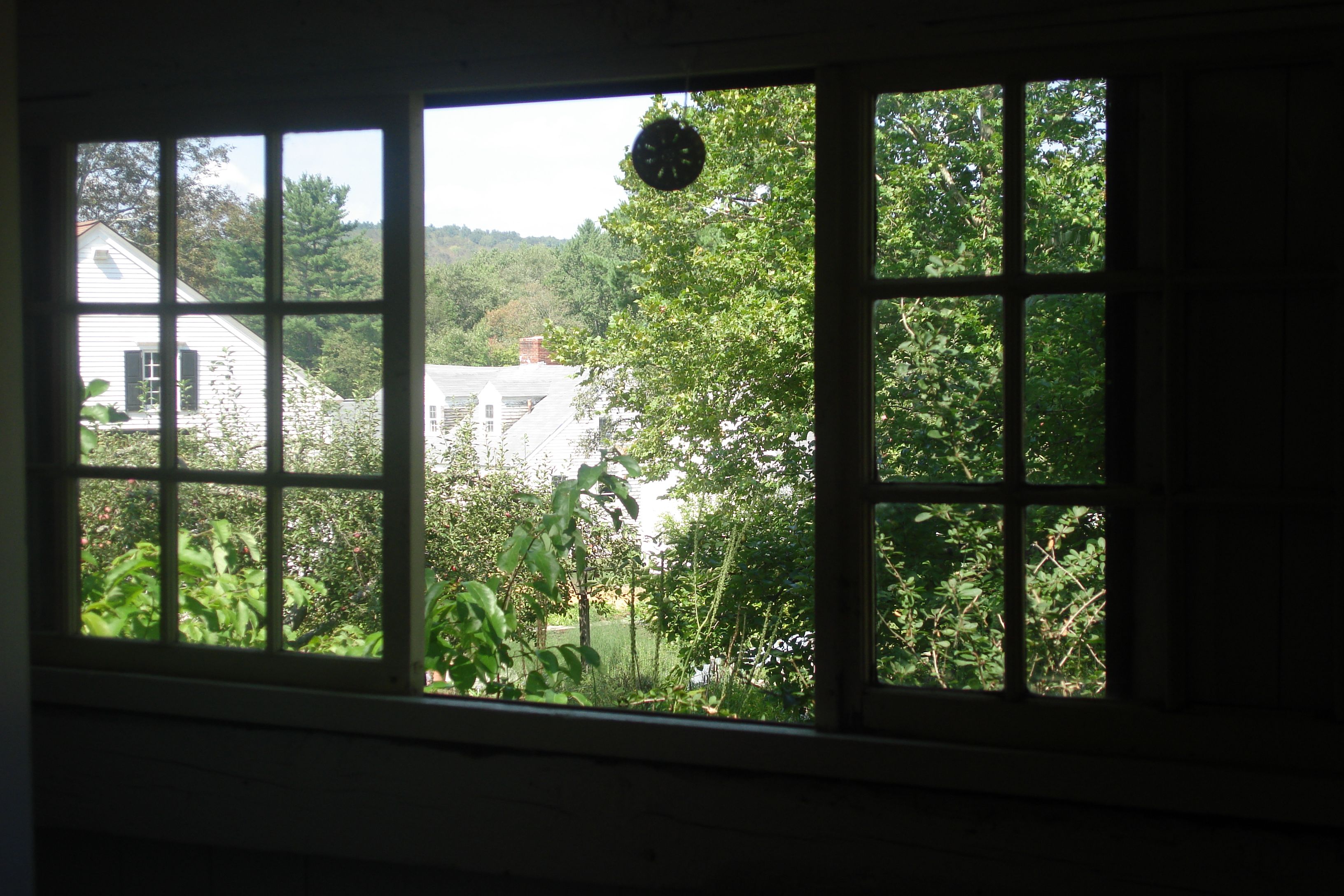
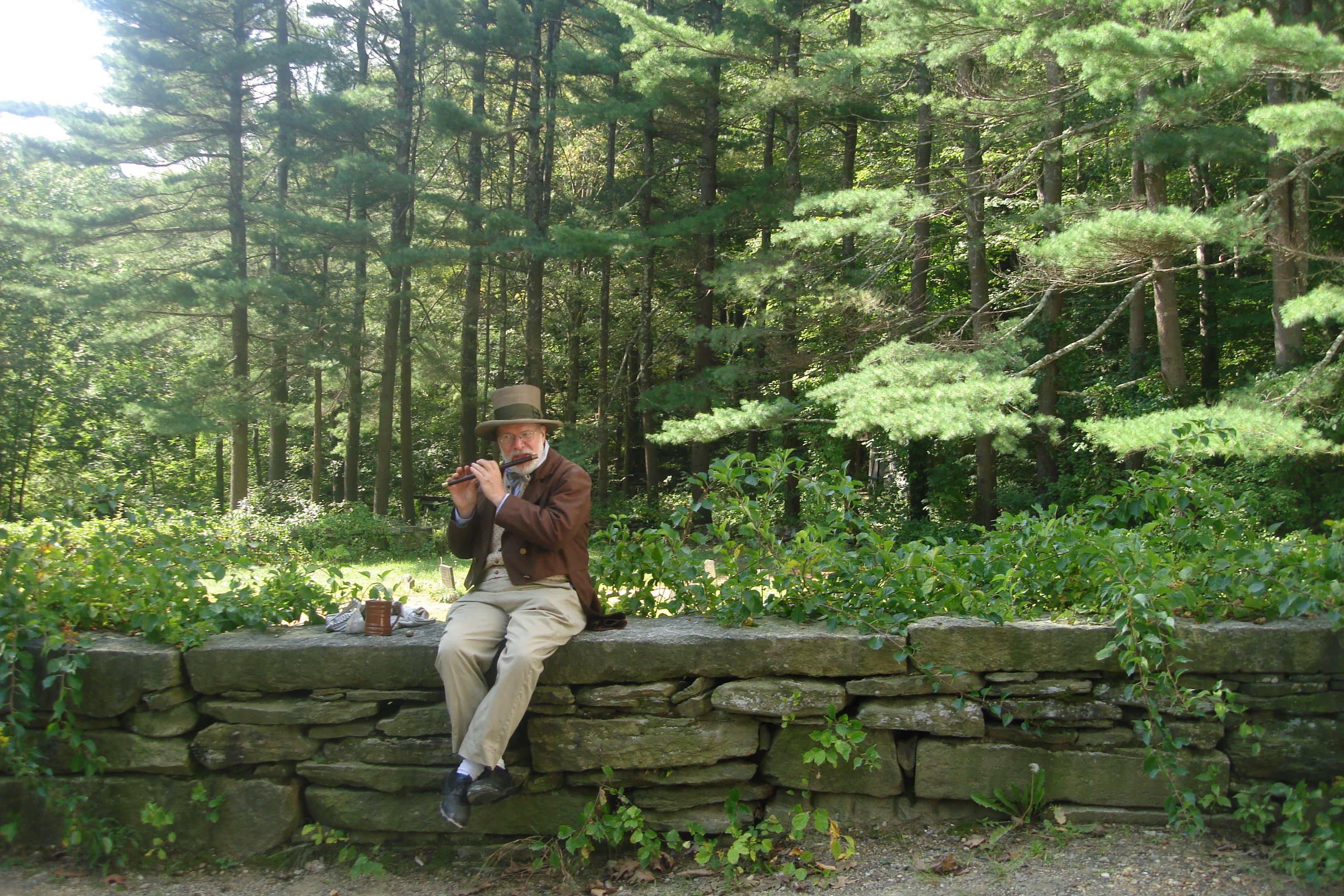
We spent our first day of school with several hundred other homeschool families at Old Sturbridge Village in Massachusetts.  This is a great way to experience first hand the daily life in a small New England village in the early 1800’s.  We were delighted with the apparent simplicity of existence and the quiet beauty of the village.

Bounce was thrilled to run into each village home He visited the Meeting House, the lawyer’s house, the Towne family home and several others.  He was able to see original writing instruments (quill pens and ink), spools of cloth, jars of pickles and nails and scales for weighing non pre-packaged merchandise.

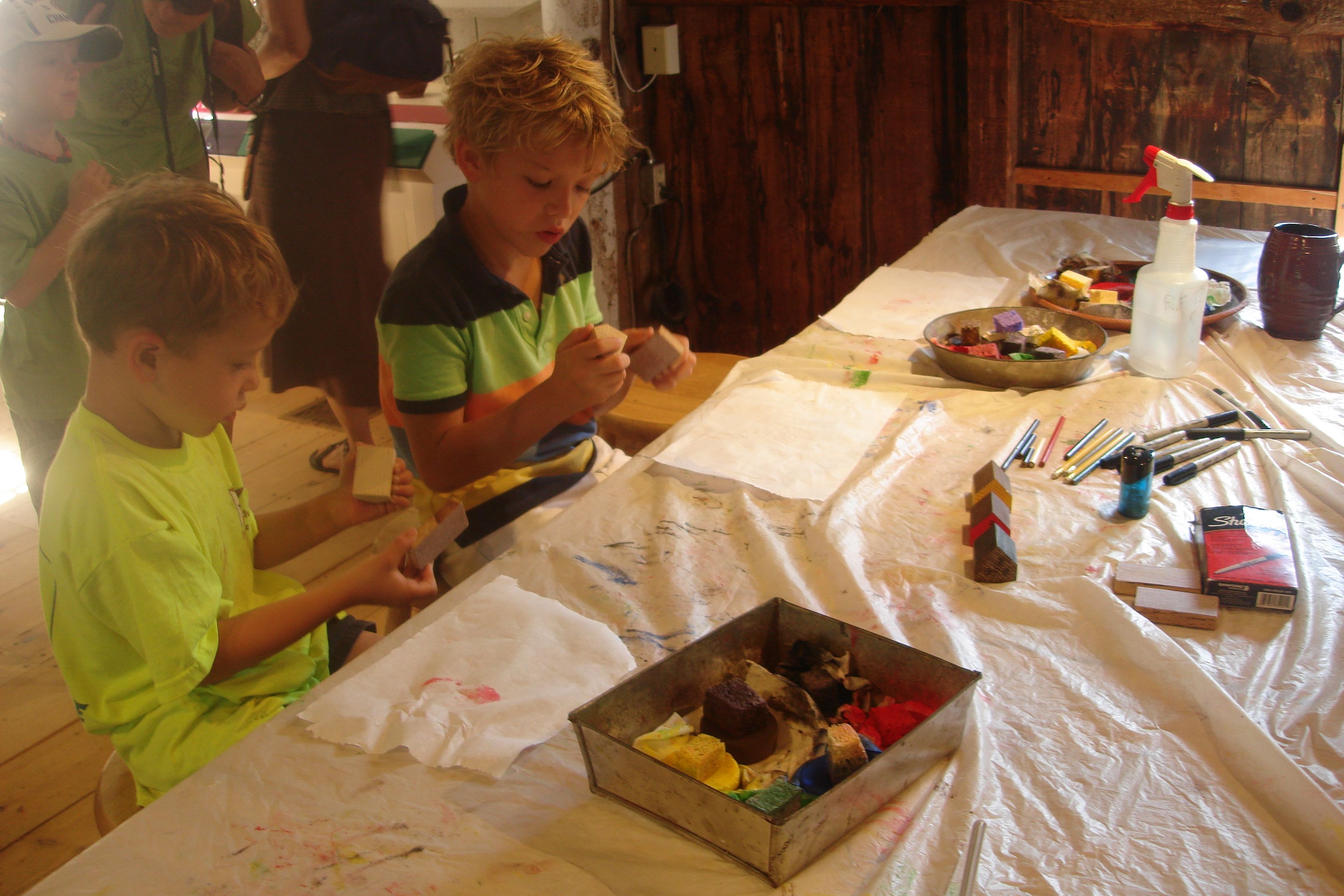
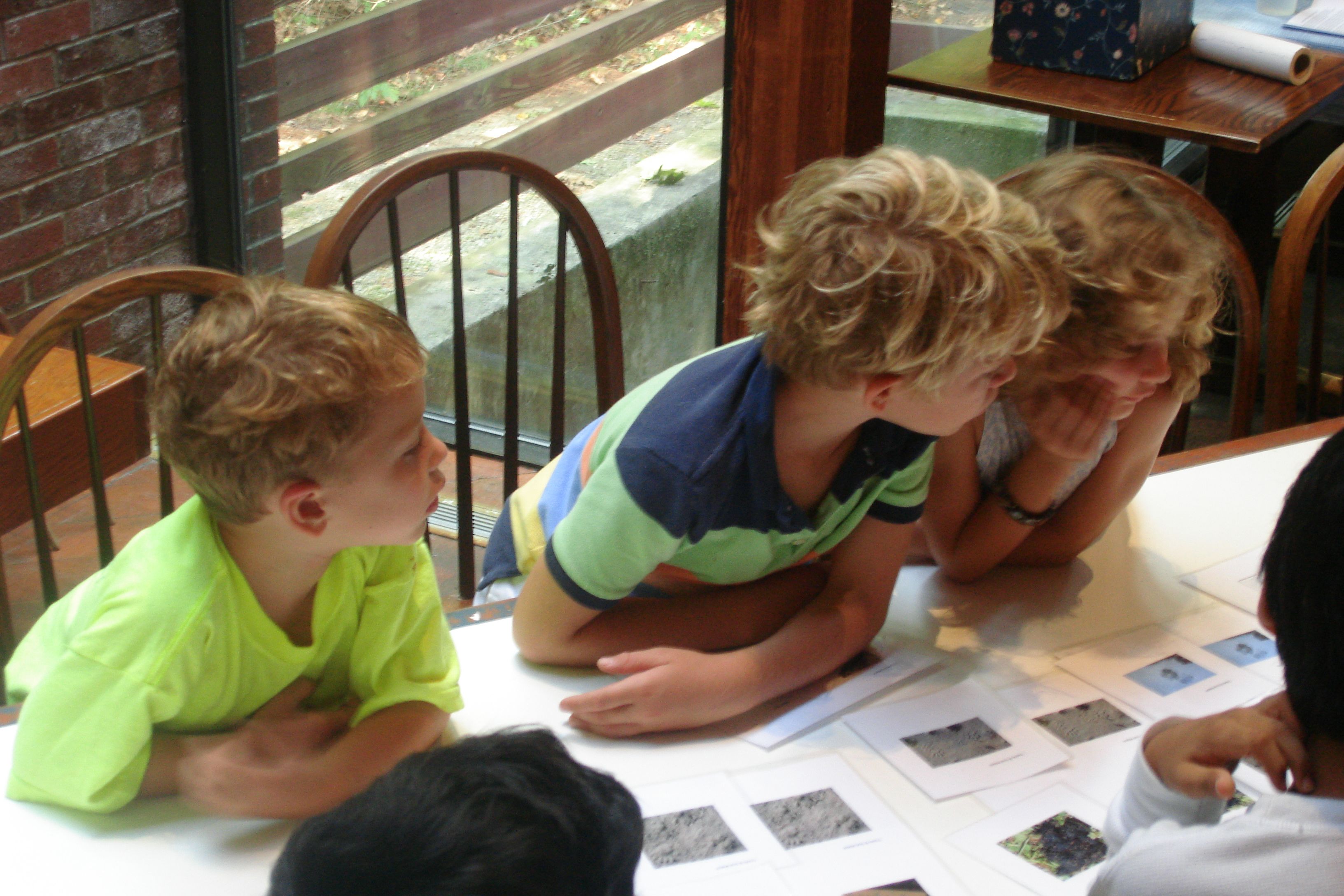
Bounce and Scooter made miniature town houses, studied archeology, made coyote footprints and also created solar photographs with leaves and flowers gathered from the garden.

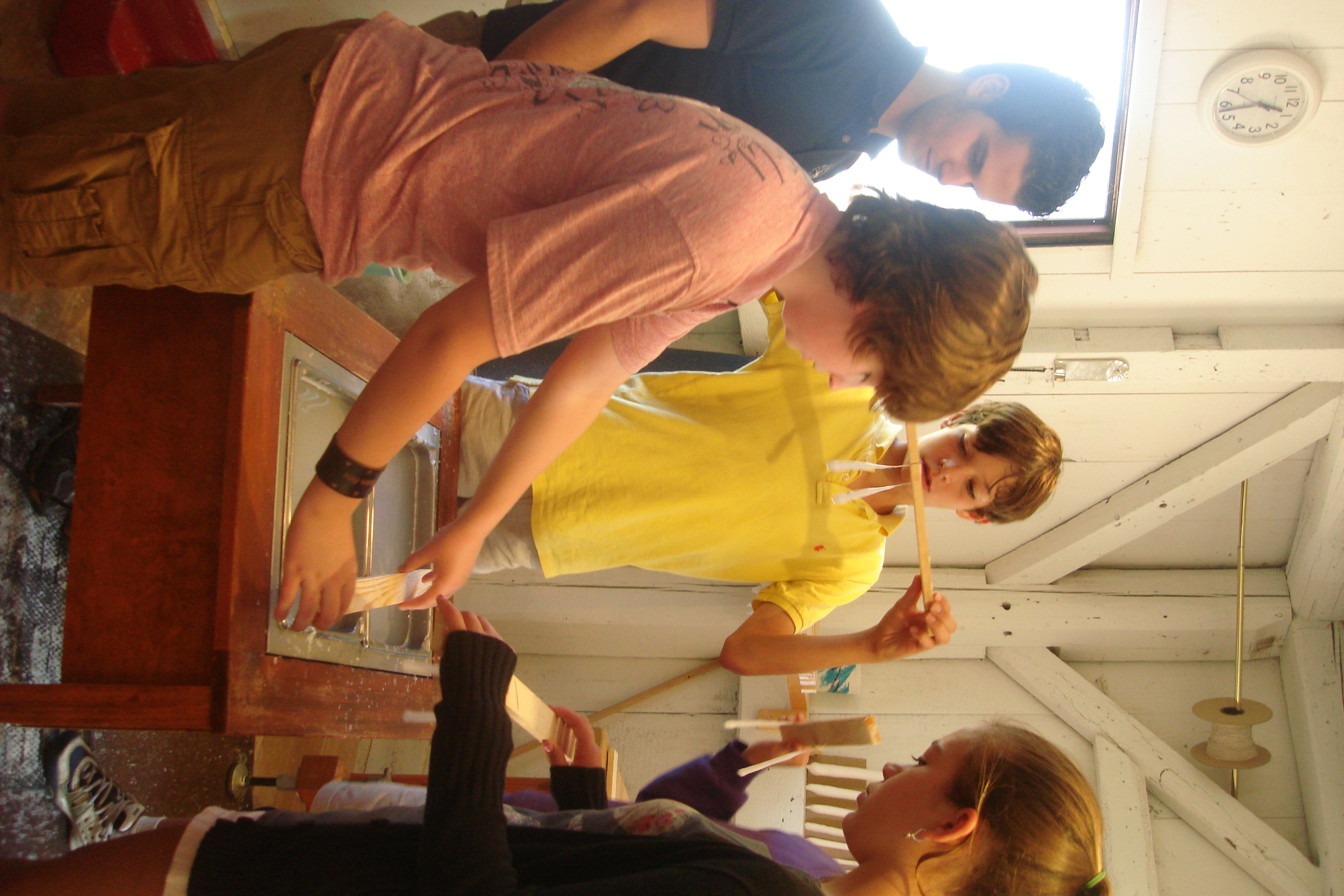
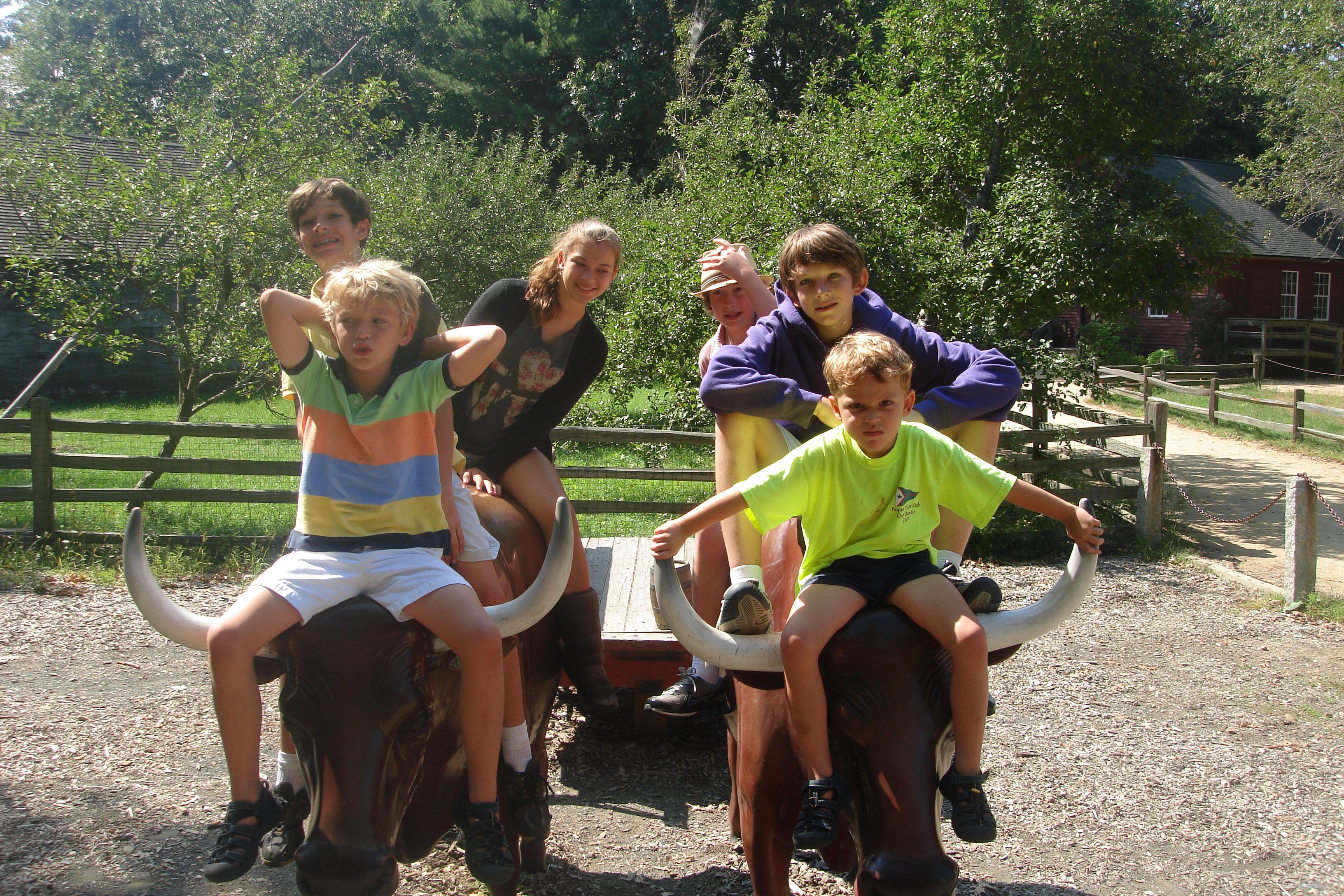
Creatress, Quantum and Truth made candles, rode an oxen team and studied hard in their faux one-room schoolhouse.

In all, this was a great opening to our study of early American history.